That was the decision I had to make at around midnight of the 4th day of the trip. A location famous for torture and indefinite incarceration without trial or one of the world’s poorest countries thus more likely to be prone to pirates? Hmm, decisions decisions. We were entering the Windward passage, a stretch of water between Cuba and Haiti that marked a major mile stone of our trip because once through that gateway we could turn West and head for Florida. It was living up to its name as the route was directly into the wind (to windward) which meant we had to tack either to the Haiti coast or towards the Cuban one. The wind was such that the Cuba option took us directly towards what looked like a nice bay until I read the name on the chart.
The Cuban option had the most comedy value. In my student days, my housemates and I watched “A Few Good Men” dozens of times and one of our favourite lines was when a gruff Jack Nicholas in Guantanamo Bay told young upstart Tom Cruise “I eat breakfast 300 yards from 4000 Cubans who are trained to kill me, so don’t think for one second that you can can come down here, flash your badge and make me nervous.” How good would it be to be able to email my ex-housemates that I was doing the same as Jack? Except we would be more than 300 yards away and I’d have to eat my breakfast at 4am. Hmm, maybe not worth it for a convoluted gag only two people might get. On Haiti’s side was the weather which was forecast to shift to the NE. As any good yacht racer knows, you always head towards the next shift so, reluctantly turning our backs on what would have been a unique comedy opportunity we put the boat on Port tack.

The 1,200 mile Colombia to Florida/Bahamas passage has been worrying me more than any other of our year long journey for a number of reasons. It can be broken into four stages each with its own challenges. The first section which covers roughly half the distance is the sail across the full width of the Caribbean Sea. With the prevailing conditions being ENE trade winds and a west setting current, we were looking at 4 days close hauled being battered by wind and waves and with only two of us on board to share the watches on a boat we barely knew. The next section is sailing through the windward passage the “wrong way” – ie against the wind and current with pretty unfriendly countries either side. The third section was probably the most benign, sailing West along the north coast of Cuba between that and the Grand Bahama bank, a massive area of incredibly shallow water, too shallow for us to cross. The final section, sailing north along the Straits of Florida could be either the easiest or the most dangerous part of the trip and it all depended on the wind direction. This is where the notorious Gulf Stream (the warm current that starts in the Gulf of Mexico and heads all the way across the North Atlantic to keep the UK warm (well let’s just say less freezing)) is at its strongest with 3 or 4 knots of current not unusual. A southerly wind would propel us incredibly quickly north, a northerly would result in wind against a very strong current which all sailors know is a big no-no creating very large and steep waves treacherous to small boats. On top of this, we would be doing this passage during the time that was still officially “hurricane season” and while late season hurricanes are rare, they are certainly possible. Oh yeah, and the second half of the passage lies within the Bermuda Triangle, just in case I needed another reason to worry.
It is for all these reasons that I had planned this trip meticulously and looked hard at every risk, working through mitigation measures and then reassessing whether the risks were acceptable which in the end I satisfied myself they were. These are just some of the factors that got me to a point where I was comfortable taking this passage on:
- Hours and hours of studying pilot charts and researching routing options
- Sound boat very well equipped with safety gear including locator beacons for both the boat and individuals and two liferafts, flares etc
- Two shake down passages prior to the big one to get to know boat, each other and optimise the watch systems
- Both crew very experienced offshore sailors who trust one another
- Invested in best weather routing systems available which includes ability to update latest forecasts whilst offshore every 8 hours
- Several planned and researched “escape options’ along the way including Jamaica and various locations in the Bahamas should we need to ride out bad weather
- Daily communications with shore team using the satellite phone
- On shore experienced meteorologist, sailor and weather router (otherwise known as Jess!) monitoring the bigger picture and providing daily weather updates and routing advice
- Only 1 alcoholic Beveridge a day (2 if its your birthday and the weather is calm) – I know I’m taking this seriously right?
You can do all the planning you like but at some point you just have to stop planning and start doing. A very nice looking weather window was opening up for a 29 October start and after getting the nod from Jess, filling up the tanks with water and fuel and fridges with food we motored out of the historic Cartagena harbour, scene of so much naval history including battles, pirates and plenty or rum and headed out into a moody Caribbean Sea, both of us a little nervous but excited about the challenge ahead.
So how did we go?
Stage 1: Cartagena to the Windward Passage
We lucked out for this one. Without being too technical, there was a weak low pressure system near Panama that counteracted the trade winds and gave us light S and SE winds for the first two days and then when the trade winds did come in, they were from a ESE direction not the usual ENE direction. The result of all that was that instead of bashing into the wind we were coasting along with the wind behind us for two days motoring when the wind was too light and sailing in very comfortable conditions when we could.

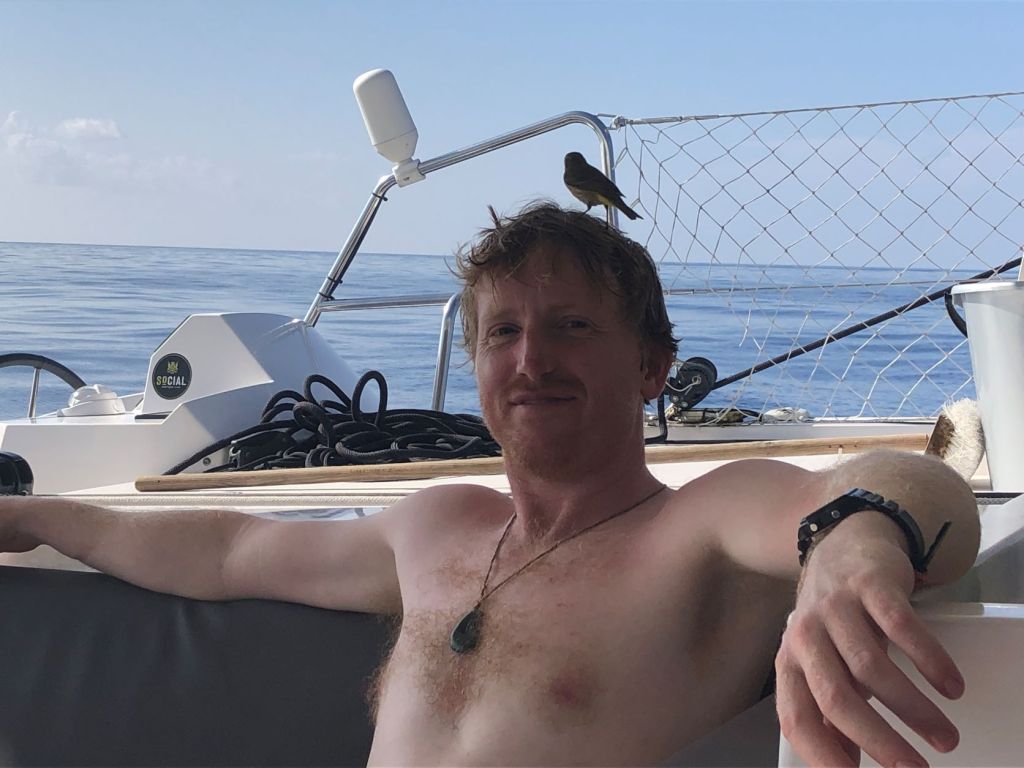
We settled into 3 hour watches at night with Tom getting a good sleep for as long as he wanted at dawn and then me going down to do the same mid morning with both of us up and about for lunch and the afternoon. It worked so well, I actually think I got more sleep then I usually do at home! On watch meant keeping an eye out for other vessels (we saw dozens of ships on the passage but not one sailing boat), rain or thunder storms on the radar, trimming the sails and entering positions and conditions in the log book. In reality, these activities take up about 10% of your on-watch time and the rest was reading, making cups of tea, preparing or eating meals, fishing, playing backgammon and listening to podcasts (in my case) and sketching (in Tom’s). At times I just enjoyed looking at the ocean and letting my mind wander. I caught myself once having just been gazing at the sea for a good half an hour completely lost in the moment and I had no idea what had been going through my mind for that time. I can’t remember being in the moment like that during my land life.

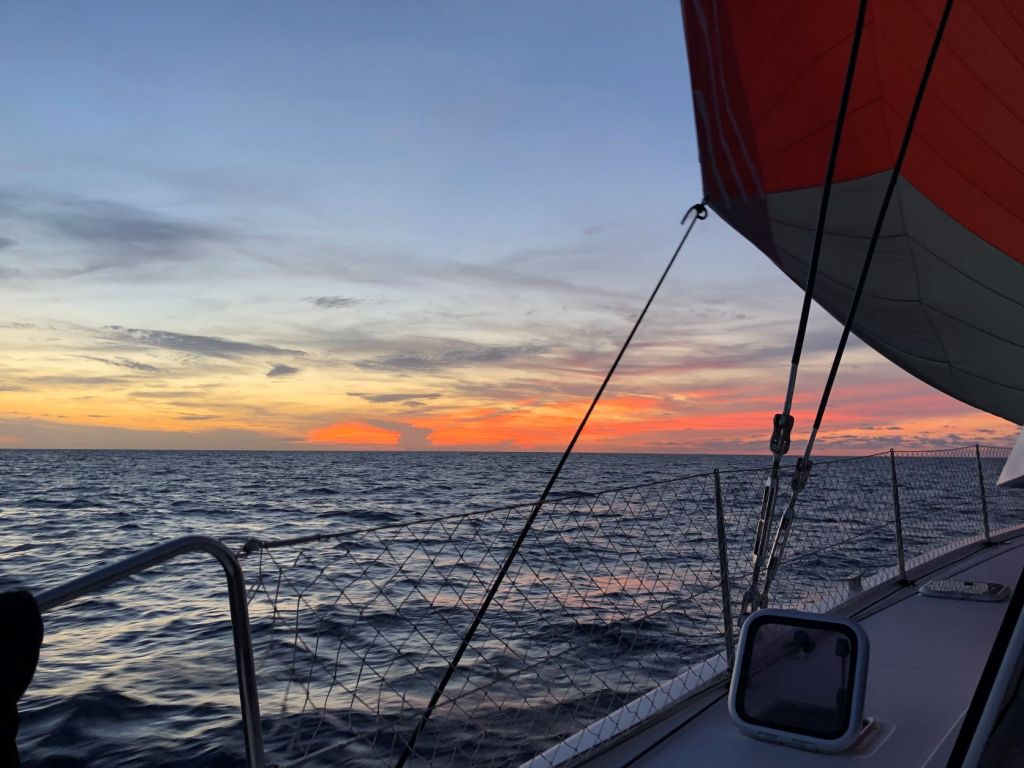
Due to the exceptional weather we would muster on the trampolines at the bow an hour before sunset to eat crisps and nuts, drink our one alcoholic drink for the day and talk about all sorts of stuff. On the second evening, as the sky was turning orange we were met with pod of dolphins playing between the bows. Much as I love Tom it would have been quite nice to swap him for Charlotte at that moment! It was a very simple but pleasant way to live and I was starting to understand why some people love the passages more than actually getting to the destination.
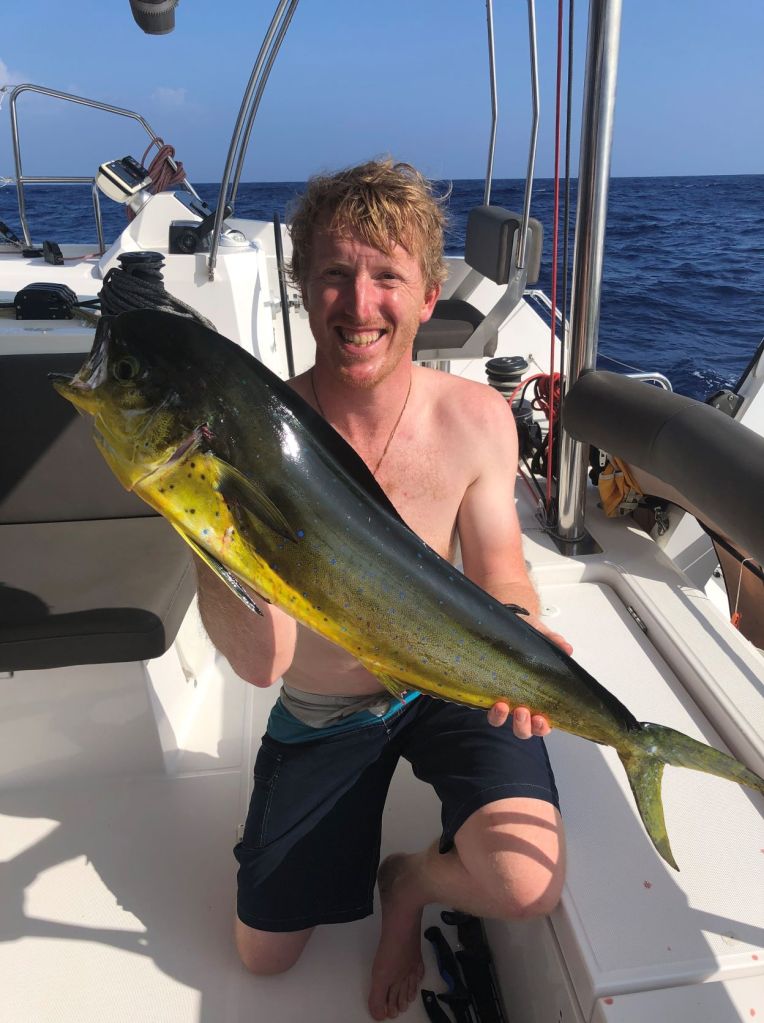
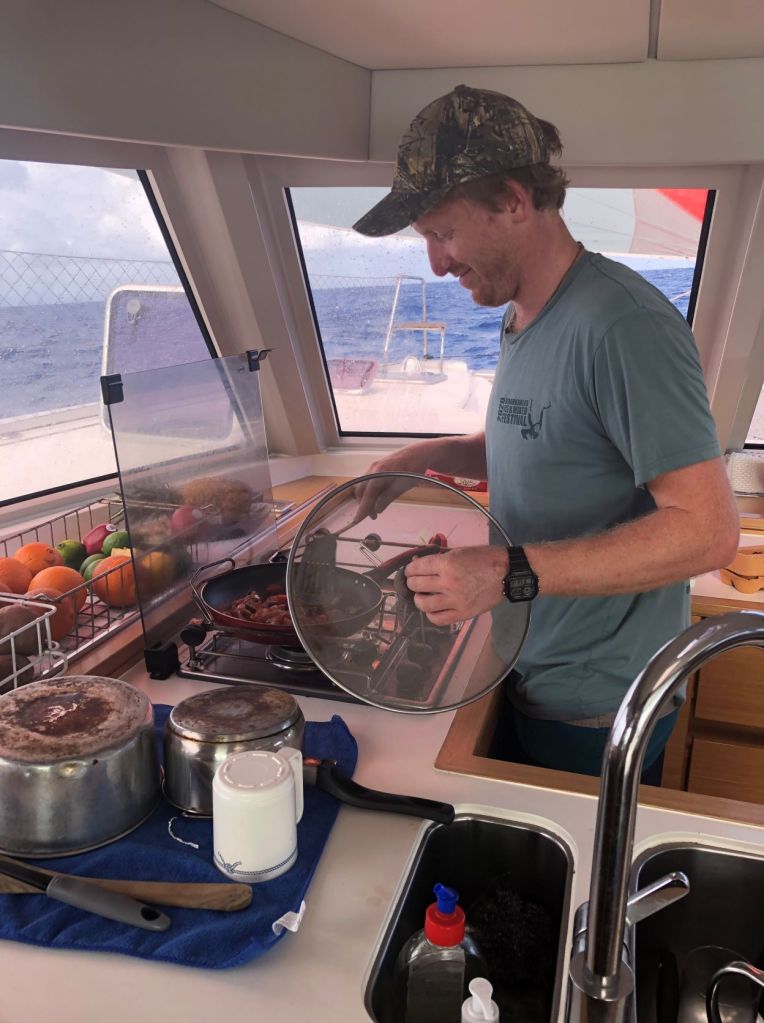
Tom caught our biggest fish of this passage on the second day after losing 3 including one monster that can only have been a marlin going by the damage to the line. After swapping what was clearly a dodgy hook for a treble hook, Tom landed the next one, a beautiful Mahi-Mahi. As per the wahoo, the cockpit soon turned into a slaughterhouse with Tom and I making short work of the filleting converting the animal into sashimi, two helpings of ceviche and two meals of fillets for frying. Delicious!
Stage 2: The Windward Passage
On the morning of the 4th day we sighted our first land since leaving Colombia, the small uninhabited island of Navassa. When looking at the chart it seemed obvious to go between this island and the SW corner of Haiti and as skipper I decided on a new rule to reduce the threat of pirates and that was Kilauea would not be sailed within sight of any country that had experienced a coup within the last few years. For this reason we kept well offshore from Haiti and close to this tiny USA owned lump of rock. At this moment I experienced the pleasure that all offshore navigators get when land is exactly where it is supposed to be. It sounds obvious but when you have been at sea for several days you never really know if lines on a chart or on a screen really will materialise into actual land until you see it with your own eyes.
We had to motor for the first part of the windward passage due to a complete absence of wind caused by being in the lee of the mountainous Haiti. We took this opportunity to turn off the engines and take it in turns diving into the deep blue 2km deep ocean, a thrilling but spooky experience. We made sure one of us was always on the boat in case a wind sprung up and the boat started drifting away. That would not have been a nice end to the journey.

One of the more amusing things that happened here was that Tom and I spent a whole day living in different time zones without realising it. It was your classic apple vs android issue that caused it. For some reason my apple devices decided enough was enough and I needed to go from Colombian time to Bahamas / Florida time. Tom’s android devices were being more purest and not changing until we actually arrived in the Bahamas. The result was Tom looking very confused when I offered him lunch at 11am and me getting frustrated the dinner he was making was being served so late. It came to a head when I told him I was going off watch for my first sleep and he told me I had to wait an hour. In the discussion that followed we finally got to the bottom of things and chose to both be on Bahamas time. Phew…
Stage 3: Grand Bahama Bank

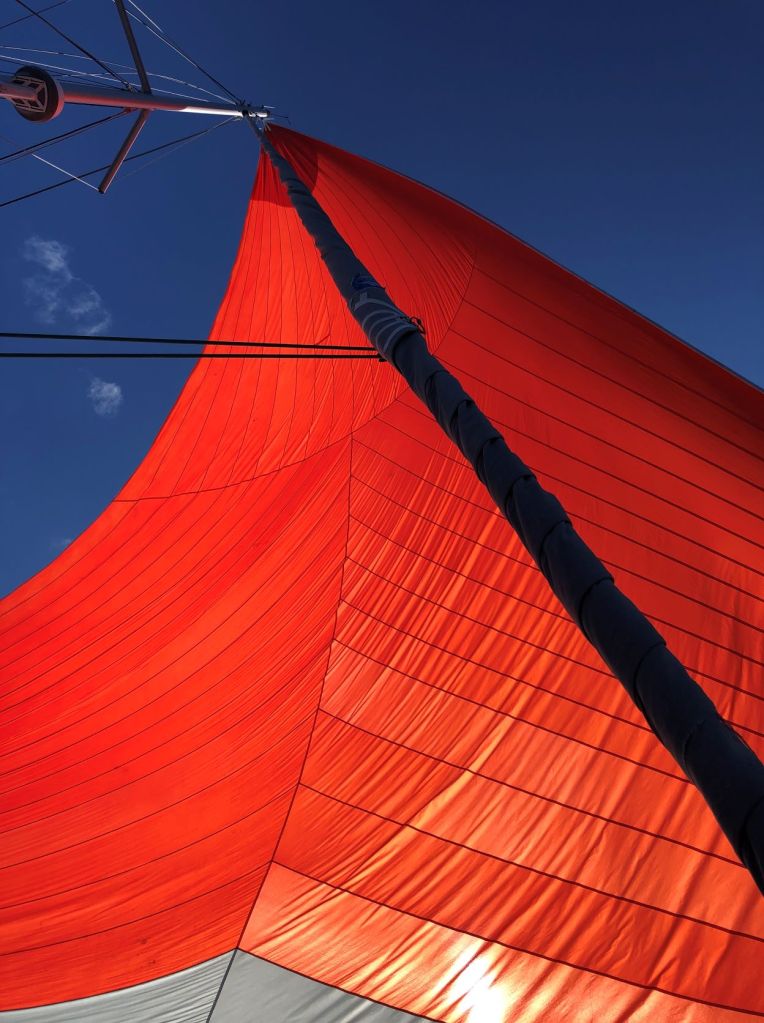
This stage ended up being the most glorious sailing we have had on Kilauea to date. We hoisted the Code D (spinnaker) early on the 4th day, dropped the main and sailed like that for almost 3 days at speeds between 5 knots when it was light winds and 9 knots+ when the winds were a bit stronger. I am continuously impressed with the speed this boat goes. It just seems to want to sail as fast as it can towards the horizon and even when you shorten sail it seems to make very little difference to speed. Whilst there is definitely less “feel” when steering compared to a monohull, this is more than made up for in speed and ease in which the boat starts surfing down waves. I’m starting to see why catamaran sailors very rarely go back to monohulls again.
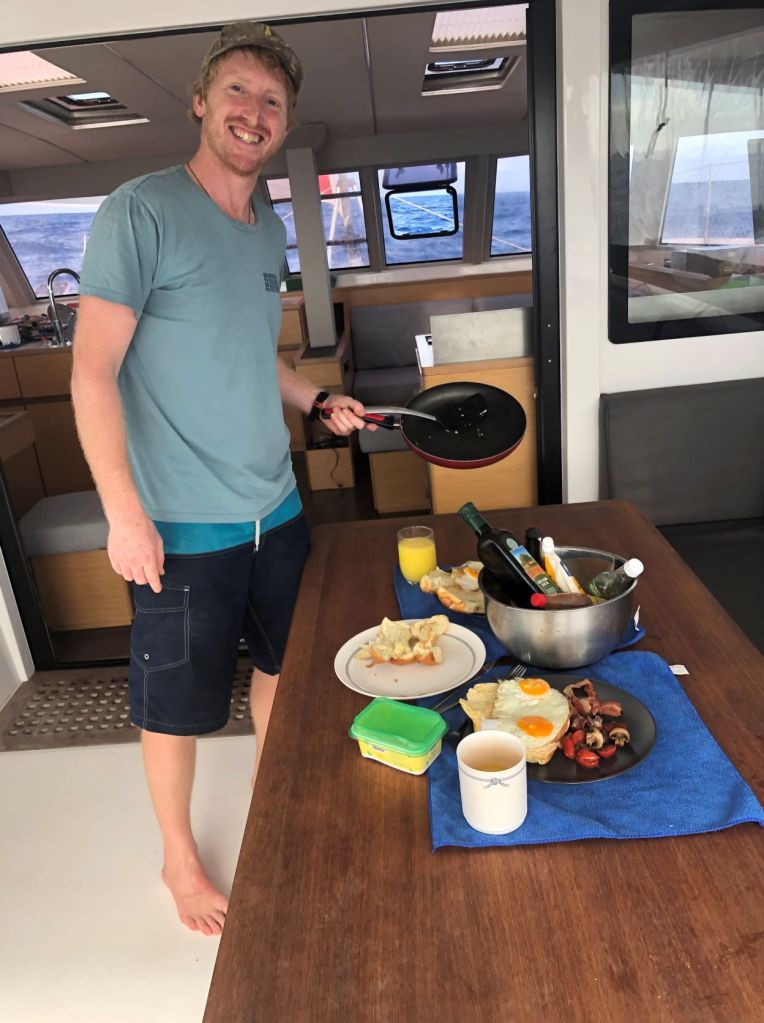
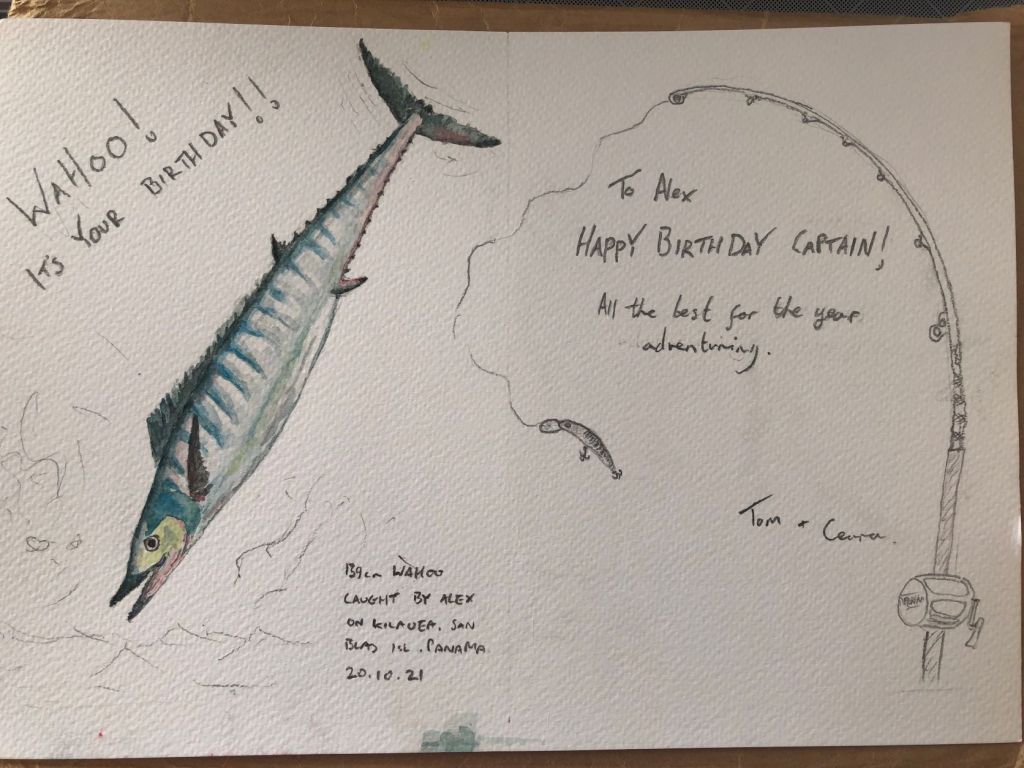
During this stage of the trip I turned 46 and Tom greeted me when I came up from my morning snooze with a full English fry up. He also surprised me with a watercolour picture of the wahoo we caught, a bottle of Colombian’s finest rum and a home made cheesecake! He’d smuggled the ingredients on board and made the cake in two stages when I was off watch at night and again the following morning. What a legend! I also opened the cards and gifts Lottie and the kids had sent me away with 4 weeks ago which was lovely but made me miss them all the more. The thing I missed most was the kids bursting into the bedroom in the morning jumping on the bed and giving me their home made cards while the dog goes nuts. Anyway, Tom and I celebrated sunset on the bow with an extra allocation of booze and then settled down to a slap up dinner of steak, fried potatoes and salad. All in all, a very pleasant way to spend your birthday.

Stage 4: The Straits of Florida
As we started to round the southern end of the grand banks and head north again, thoughts were turning to the Gulf Stream and associated weather. We were now out of the effects of the Trade Winds and into the weather systems coming off the continental USA. This is where Jess, our weather router, really came into her own.
I cannot over-state how important it was to have Jess providing us weather information for this trip. Every morning I would eagerly await her daily weather update and I’d read it out to Tom as I read it myself. Often I would go back to it several times over the course of the day as there was so much information written in a few brief paragraphs that it took a bit of digesting. Jess is unashamedly a weather nerd and I love her for it. She clearly loves interpreting and explaining weather systems and impacts and is very very good at it. So good that even Sir Ben Ainslie, my all time sailing hero, has employed her to give him advice for his Bermuda Americas Cup campaign. She would take all sorts of information well beyond what most people look at when considering the weather, review various models (including once looking at all 20 “members” of one of the models to get a feel for the sensitivity) and then boil that all down into what weather we were likely to experience, what route we should take to optimise the conditions and a summary of what was causing the weather to be that way. The last bit was my favourite. You could tell Jess was trying to keep things understandable to a layman like me but she couldn’t help using jargon like “the low will retrogress southwards” and “there is a large mesoscale convective cluster” from time to time which sounded really cool even if I didn’t really know what it meant.
Anyway, you could tell from the increasingly serious tone of her usually lighthearted emails that she was getting worried about our approach to the Gulf Stream with a strong front forecast with gale force winds and some massive thunderstorm cells on their way. After discussing the situation in detail with Tom, I made the executive decision to cut short our passage by 65 miles and put in at Bimini instead of the original plan which was Grand Bahama further north. The Bimini option was one of my “bail out options” I had studied before we left so it felt good to be executing a plan we had previously developed for just such a scenario and it meant we were guaranteed to be safely tied up in a sheltered marina before the bad weather hit. When I told Jess of this plan, her next weather report was much more relaxed again.
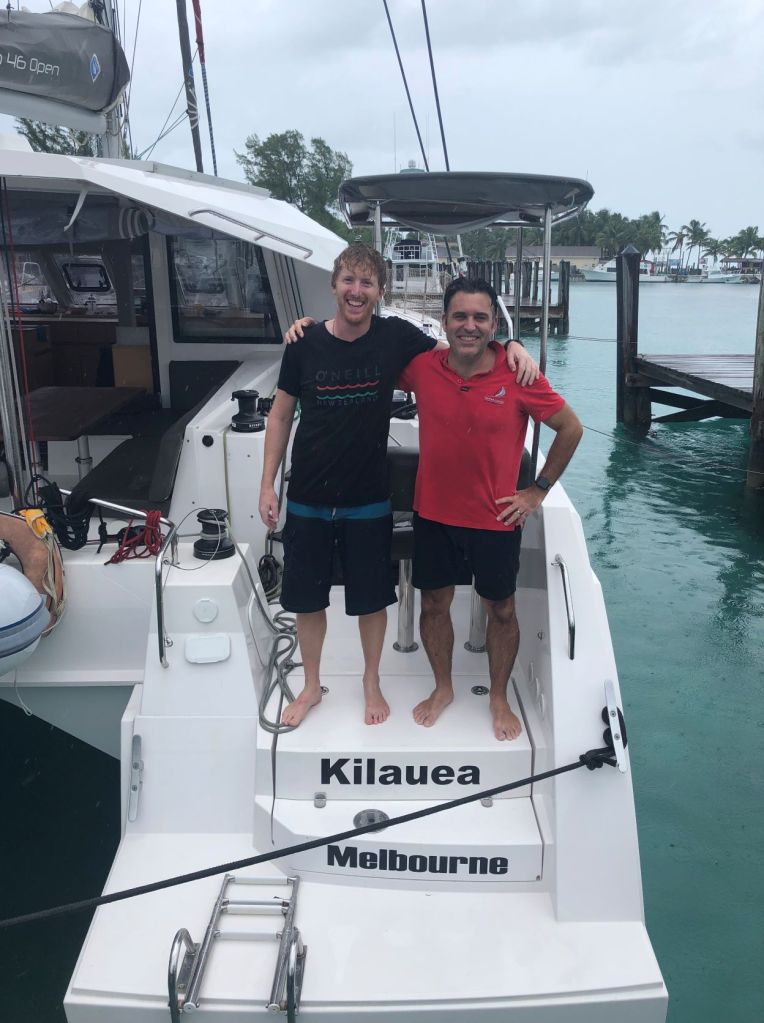
And so it was we found ourselves off the entrance to Bimini just as the sun was rising through the thunderstorms and navigated our way through the shifting sand banks in the poring rain into the Bimini channel and found somewhere to moor up. There were multiple marina options so we chose the one that had the sailing boats in it (rather than sportfishing boats), only 3 but at least we would be amongst like minded people.
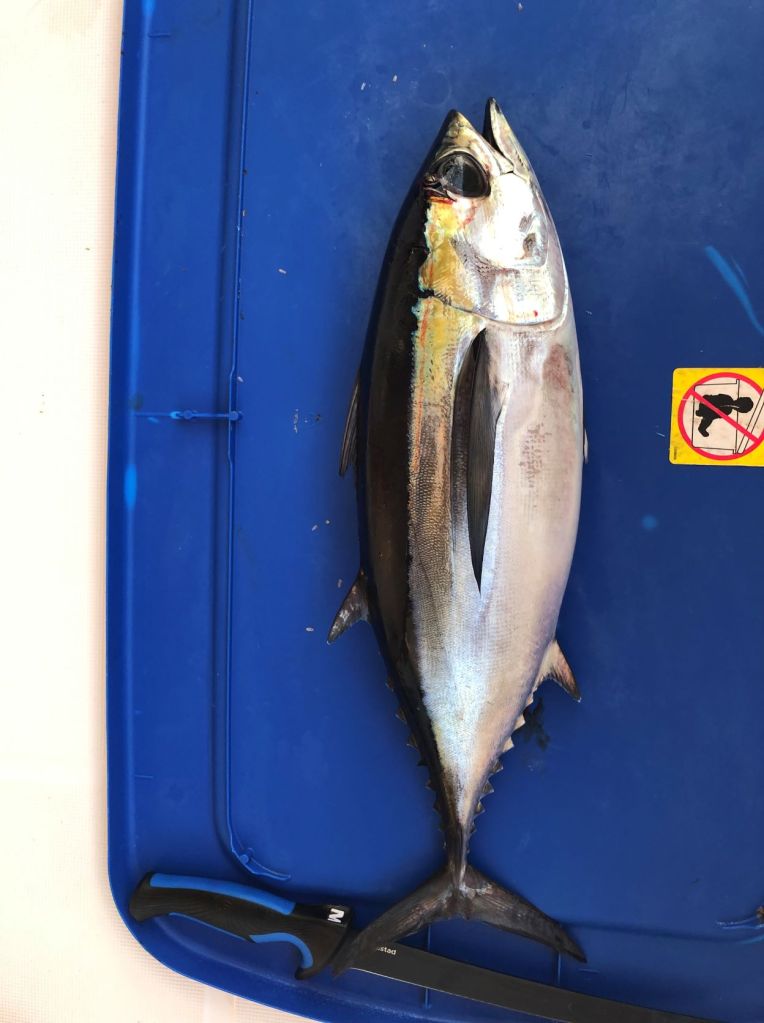
After covering all this distance so successfully we almost came a cropper trying the moor the boat into a very narrow berth in strong side winds and were inches away from nudging a pile with the bowsprit and sideswiping another boat. Miraculously, after two aborted attempts we were safely tied up and could breath a big sigh of relief. We had sailed from South America to North America in just under 7 days covering 1,150 nautical miles at an average speed of 7.3 knots and caught 2 fish that were “keepers” along the way, the magnificent Mahi-Mahi and the more modest albacore I reeled in on the 6th day. All in all I felt we deserved the burgers and beers we celebrated with before we turned in for 9 hours of blissful unbroken sleep.
 Sailing Kilauea
Amazing! Nice to read a “real” ocean sailing blog that doesn’t brush over the planning and hard work required for such an expedition. Also 100% agree Jess is a legend. Loving the updates Alex.
LikeLiked by 1 person
Well done Alex and Tom, a great achievement and a great read this morning. Sounds like all your planning paid off and you learnt a lot about sailing the boat also with Jess playing a very important role. Your confidence must have taken a real boost too. Enjoy the beers and burgers on Bimini! Cheers Bill
LikeLiked by 1 person
Loving all the fish and cooking pics!
LikeLike
Great to hear that you have arrived safe and sound!!! Must have been a bit nerve wracking at times!! Thank goodness for Jess, what a legend, and of course all of your expertise and hours spent researching and planning!!! I was worried when your boat seemed to be at 0 knots in the middle of nowhere…..Charlotte explained I needed to zoom in and that you were actually moored on a tiny spec of an island! Phew!!
LikeLike
Great reading just read all your blogs
LikeLike